Job Interview FAQ Templates: The Ultimate 2026 Guide for Smarter Hiring
Have you ever walked out of an interview thinking, “That didn’t go as planned”—not because the candidate was wrong, but because the questions were? You’re not alone. Across industries, hiring managers and HR professionals struggle with inconsistent interviews that waste time and miss great talent.
That’s where job interview FAQ templates come in. These structured frameworks ensure every interviewer asks the right questions, stays compliant, and delivers a consistent, fair experience for every candidate. Whether you’re a business owner, product manager, educator, event planner, or HR professional, using templates can completely transform your hiring process in 2026.
In this detailed guide, we’ll explore what job interview FAQ templates are, how to build and use them effectively, and why they’re crucial for efficient hiring in a global, remote-first world.
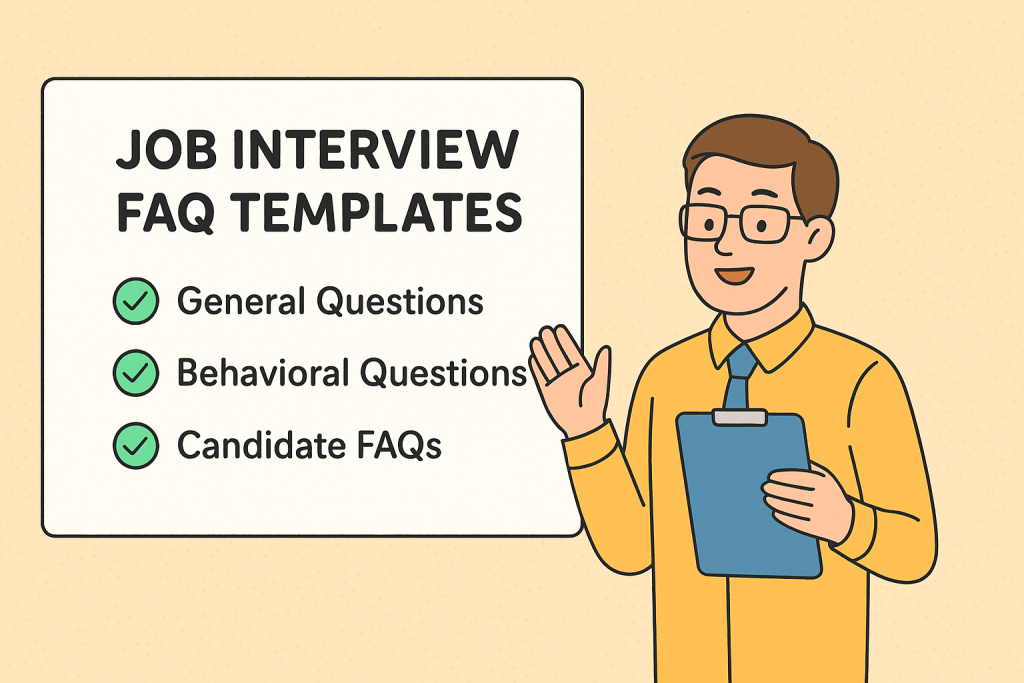
What Are Job Interview FAQ Templates?
A job interview FAQ template is a ready-to-use question framework that helps interviewers structure the conversation, cover key evaluation areas, and answer common candidate questions.
Instead of improvising, these templates guide interviewers through essential sections like:
Introduction & context – sets tone and purpose.
Core interview questions – evaluates skills, mindset, and fit.
Candidate FAQs – ensures transparency and engagement.
Evaluation notes & scoring – enables fair comparisons.
Think of it as a map for your interviews—you always know where you’re going and what outcomes to expect.
Why Every Organization Needs Interview Templates
A recent study by LinkedIn found that structured interviews are 81% more predictive of job success than unstructured ones. Yet many organizations still rely on gut feeling or last-minute prep.
Here’s why that’s risky:
Inconsistency leads to bias – Without standardized questions, unconscious bias creeps in.
Lost productivity – Each interviewer wastes time recreating questions.
Poor candidate experience – Candidates sense when interviews are disorganized.
Inaccurate assessments – Without a scoring guide, feedback becomes subjective.
Job interview FAQ templates solve these problems by promoting structure, fairness, and clarity. They also help you comply with labor laws and DEI (diversity, equity, inclusion) standards—an essential consideration in global hiring.
Who Benefits from Job Interview FAQ Templates?
Let’s explore how different professionals can leverage these templates.
1. Business Owners
For startups or small businesses, time is money. Interview FAQ templates save hours by:
Standardizing interview formats across departments.
Reducing costly mis-hires.
Ensuring every interviewer follows legal and ethical guidelines.
Example: A small marketing agency can use templates to evaluate creative skills and client-handling capabilities across all candidates—without missing critical questions.
2. Product Managers
Product managers often hire cross-functional roles—engineers, designers, analysts. Using structured templates ensures they:
Ask role-relevant, outcome-driven questions.
Compare candidates objectively across skill sets.
Maintain fairness in technical and non-technical evaluations.
Create specialized sections in your FAQ template for “Product Sense,” “User Empathy,” and “Problem Solving.”
3. Educators & Course Creators
For educators, consistency is key. Job interview FAQ templates help:
Evaluate teaching style, engagement, and communication clarity.
Ensure alignment with institutional values and learning outcomes.
Simplify global hiring for remote instructors or online tutors.
Example: A global e-learning company can use a unified FAQ template to hire instructors from different countries while maintaining consistent quality.
4. Event Planners
Event planners often build temporary or project-based teams. Interview templates allow them to:
Assess organizational and crisis management skills.
Quickly onboard reliable team members.
Maintain professionalism in high-pressure hiring cycles.
Example: When hiring event coordinators for a global conference, standardized templates ensure candidates are evaluated on adaptability and stress management.
5. HR Professionals
HR teams are the primary champions of structured hiring. Templates help them:
Align hiring practices across departments.
Ensure compliance with regional employment laws.
Improve hiring data accuracy (e.g., score consistency).
Combine your FAQ templates with automated HR tools or form platforms to track performance analytics over time.
Anatomy of a Winning Job Interview FAQ Template
Below is a breakdown of essential sections your template should include.
1. Introduction Script
Begin with a professional yet welcoming script:
“Thank you for joining us today. I’m [Name], [Title]. We’ll discuss your background, explore the role, and give you time for questions at the end. Feel free to answer openly—this is a two-way conversation.”
Including this in your template ensures every candidate has a consistent first impression.
2. Core Interview Questions
These form the backbone of your process. Group them into categories:
a. General Questions
Tell me about yourself.
Why do you want to work with our company?
What motivates you in your career?
b. Behavioral Questions (STAR Method)
Describe a time when you handled a conflict in a team. What did you do?
Give an example of a project where you had to meet a challenging deadline.
c. Role-Specific Questions
For Product Managers: “How do you prioritize features when resources are limited?”
For HR Pros: “How do you handle sensitive employee information?”
For Educators: “How do you adapt lessons for diverse learning styles?”
d. Situational Questions
“If a client disagrees with your approach, how would you handle it?”
“How would you manage multiple projects with competing deadlines?”
These categories create a comprehensive and balanced interview.
3. Candidate FAQs Section
Top organizations now include a candidate FAQ section in their templates to ensure transparency. Examples:
Common Candidate FAQs
What does the onboarding process look like?
How is success measured in this role?
What opportunities exist for growth and training?
What is the company culture like?
How soon will I hear back after this interview?
Answering these consistently improves employer branding and candidate trust.
4. Evaluation Rubric & Notes
A structured rating sheet helps reduce subjectivity.
| Category | Description | Score (1–5) | Notes |
|---|---|---|---|
| Technical Skills | Job-specific abilities | ||
| Communication | Clarity, articulation | ||
| Problem-Solving | Logical thinking | ||
| Cultural Fit | Alignment with company values | ||
| Overall Impression | Confidence & enthusiasm |
Encourage interviewers to fill this out immediately after each interview to avoid recency bias.
5. Closing Script
End consistently and professionally:
“It’s been great speaking with you today. We’ll review all interviews this week and update you by [specific date]. Do you have any final questions for us?”
This script reinforces structure and professionalism while keeping candidates informed.
How to Create Job Interview FAQ Templates (Step-by-Step)
Here’s how to build your own template system from scratch:
Step 1: Identify Core Competencies
List the top 5–7 skills each role requires (technical, behavioral, cultural).
Step 2: Draft Questions per Competency
Use proven frameworks like STAR (Situation, Task, Action, Result) for behavioral questions.
Step 3: Add Candidate FAQ Section
Think from the candidate’s perspective. What would you want to know before joining?
Step 4: Create a Rating System
Use a 5-point scale (Excellent–Poor) for each competency.
Step 5: Automate the Process
Digitize your templates using a form or document automation tool. This ensures version control, analytics tracking, and easy sharing across teams.
Best Practices for Global Use
In 2026, many organizations hire across borders. Here’s how to adapt your templates for global efficiency:
Use inclusive language. Avoid idioms or regional jargon.
Comply with local laws. Some countries prohibit questions about age, family, or religion.
Offer flexible formats. Video, phone, or written interview options.
Respect time zones. Always list times in UTC for clarity.
Add accessibility options. Provide accommodations for candidates with disabilities.
A truly global template reflects cultural sensitivity and fairness.
Mistakes to Avoid
Even the best templates can fail if not maintained properly. Watch out for these pitfalls:
One-size-fits-all approach – Customize per role; a creative director and data analyst shouldn’t have identical questions.
Ignoring candidate feedback – Always collect post-interview feedback to refine templates.
Failure to train interviewers – Tools only work if people use them correctly.
Outdated questions – Review templates annually to align with evolving skills.
Skipping evaluation notes – Without written notes, discussions become subjective.
Future of Interviewing in 2026
As AI, remote work, and data-driven hiring continue to grow, job interview FAQ templates will become smarter. Expect:
AI-assisted question generation based on job descriptions.
Real-time analytics to assess candidate engagement.
Automated transcription & scoring tools for consistency.
Global hiring dashboards integrating cultural and linguistic adjustments.
By adopting templates now, you future-proof your hiring for the decade ahead.
Frequently Asked Questions (FAQs)
Q1. What’s the difference between interview templates and FAQ templates?
A1: Interview templates focus on interviewer questions. FAQ templates include both interviewer and candidate questions, ensuring a two-way communication process.
Q2. Can I use the same template for virtual interviews?
A2: Yes! Just include additional FAQs about technical setup, meeting links, and time-zone coordination.
Q3. How many templates should a company have?
A3: Ideally one master template per department, plus 3–4 variations for specific roles.
Q4. How do I make sure my templates stay compliant?
A4: Review them with your HR or legal team annually to remove sensitive or discriminatory questions.
Q5. Are there tools to create automated templates?
A5: Yes. Platforms like FormBot allow you to design, store, and reuse digital templates easily—with workflow automation and analytics.
Final Thoughts
Your hiring process defines your company’s future. Poor interviews lead to poor hires; structured interviews create thriving teams.
By using job interview FAQ templates, you’re not just saving time—you’re building a fair, scalable, and data-driven hiring system for 2026 and beyond.
Start today: audit your current interviews, identify gaps, and use a template system that works for your team.
👉 Ready to simplify and automate your hiring templates?
Register now at FormBot and start creating powerful, reusable job interview FAQ templates today!
Get Started and Create Forms for Free?
 (1 votes, average: 5.00 out of 5)
 Loading...